
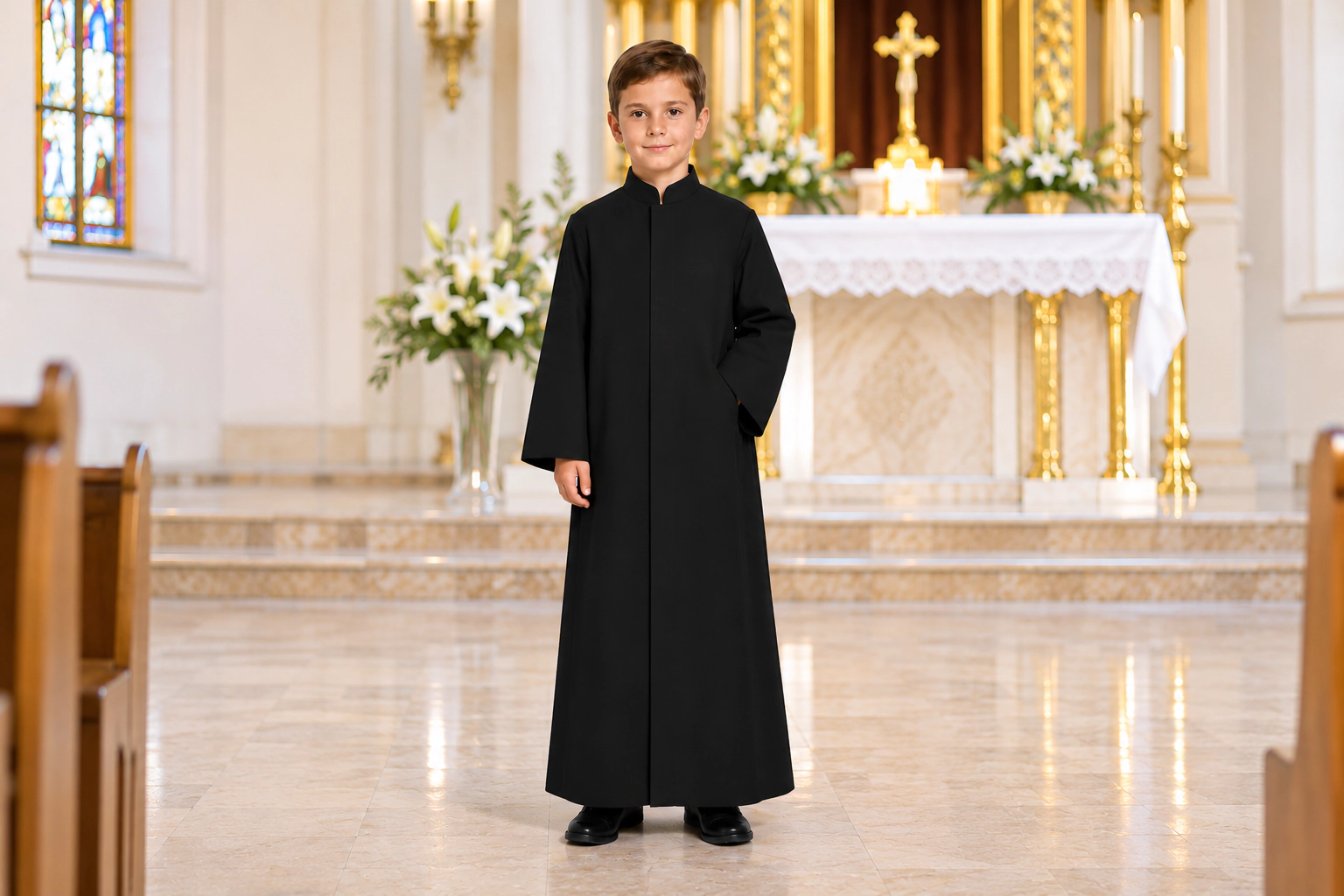
Altar Server Attire—Where to Start When Choosing?
Before purchasing a vestment, it’s a good idea to find out what types of vestments are used in a particular parish. In one parish, altar servers may serve in albs, while in another they may wear surplices, server's cassocks, or sets that include a cape.
Therefore, the first step should not be choosing a color or style, but rather speaking with the pastor or the coordinator of the liturgical altar service.
It is worth determining:
- what type of vestment is required or customary in the parish;
- whether the attire should be uniform for the entire group;
- what colors are permitted;
- whether additional elements, such as a cape, collar, or sash, are needed;
- whether the parish specifies a particular style or finish.
This makes it easier to choose an outfit that is appropriate for the liturgy and in keeping with established customs.


What are altar server's cassocks?
A sutanella is a liturgical garment whose cut is reminiscent of a cassock. It can be used as part of an altar server’s attire, depending on the customs and organization of the ministry in a given parish.
When choosing a server's cassock, it is important to pay attention primarily to:
- the appropriate length;
- comfort while walking and kneeling;
- a good fit at the shoulders and sleeves;
- the fastening method;
- how well it pairs with the rest of the outfit.
The server's cassock should drape well on the child’s figure but must not restrict freedom of movement. The altar server wears it during the liturgy, so comfort is just as important as its aesthetic appearance.
Before ordering, it’s a good idea to check whether the server's cassocks are to be worn on their own or in combination with surplices, capes, or other items. This will help you choose the right style and avoid unnecessary purchases


Altar Server Cape – When Is It Needed?
An altar server cape may be part of the attire used in certain parishes or during specific ceremonies. Its appearance, color, and manner of wearing should conform to local customs.
A cape can complement the outfit and give it a more solemn character. However, it’s worth remembering that it isn’t a mandatory part of every altar server’s outfit—the decision depends on the established rules.
Before choosing a cape, it’s a good idea to determine:
- whether all altar servers wear it, or only certain groups;
- what color is required in the parish;
- what length would be appropriate;
- whether the cape should be worn over an alb, a surplice, or another vestment;
- whether the style should be the same for the entire group.
If the parish is ordering vestments for several or a dozen altar servers, it’s a good idea to agree on a common design in advance. This will ensure that the entire group presents a unified appearance during the ceremony.


Surplice, alb, or server's cassocks—how do these vestments differ?
Choosing an altar server’s vestment can be difficult, especially for parents who are preparing their child to serve at the altar for the first time.
The most important thing to remember is that these garments differ in cut, how they’re worn, and their intended use. You shouldn’t assume that every piece can be freely combined with the others.
Altar server's surplice
A surplice is a shorter liturgical garment, usually worn over other clothing or a vestment. Its cut and finish may vary depending on the model and parish customs.
When choosing a surplice, it’s worth paying attention to the length, sleeve width, collar style, and finish.

Altar Server Alb
An alb is a long, light-colored liturgical alb. Its length and cut should be appropriately tailored to the altar server’s height and the parish’s requirements.
See also First Communion albs for boys—when choosing a liturgical alb, pay attention to the cut, length, and fit.
Sutanella
The server's cassocks are cut in a style reminiscent of a cassock and can serve as the basic element of the attire in parishes that use this style.
Before purchasing, it’s a good idea to check what other items are intended to be worn with it.
What altar server accessories can complement the outfit?
Accessories should be selected to match the specific outfit and the rules in effect at the parish. Not every altar server needs all the items, so it’s best to determine the complete set in advance.
Depending on the chosen outfit, the following may be needed:
- altar server's collar;
- cape;
- a belt or cord;
- appropriate footwear;
- additional items specified by the group leader.
When selecting accessories, make sure they match the vestment. The color, length, and finish should form a cohesive whole.
If you’re putting together an outfit for a child, it’s best to prepare a list of items approved by the parish and place your order based on that list.
How do you choose the right size for an altar server’s vestments?
A well-fitting outfit should allow for freedom of movement and drape properly during the liturgy. A vestment that is too short may look unattractive, while one that is too long may make walking difficult.
Before purchasing, it’s a good idea to check:
- the child’s height;
- sleeve length;
- the total length of the vestment;
- shoulder width;
- the measurements needed to ensure a proper fit for a specific model.
If you’re ordering outfits for a larger group, it’s best to collect the measurements of all altar servers following a single set of instructions. This will make it easier to compare the data and reduce the risk of errors.
Altar server vestments for the entire parish—how to plan your order?
When purchasing vestments for a larger group, it’s a good idea to start by establishing common guidelines. This way, parents won’t have to guess which style to choose, and the parish can ensure a uniform look for the altar servers.
A practical step-by-step guide:
- Consult with the pastor to determine the type of vestment and any required accessories.
- Choose a style and color appropriate for the parish.
- Check whether the vestments should be identical for the entire group.
- Collect the children’s current measurements.
- Determine the number of sets and the date by which they are needed.
- Before confirming the order, check that each set is complete.
If your parish is planning a larger order, it’s a good idea to contact MK Maryla to discuss the group’s needs.
Ask about outfits for your parish
How do you care for an altar server’s vestments?
Liturgical vestments should be prepared for every celebration. Care instructions depend on the fabric and the manufacturer’s recommendations, so be sure to check the information on the label or product card before washing.
It’s worth remembering a few simple rules:
- store the vestment on a hanger;
- check its condition before the celebration;
- remove stains according to the fabric care instructions;
- do not iron any parts unless the manufacturer recommends it;
- store accessories together with the outfit.
This will ensure the outfit is ready to wear and make it easier to avoid finding that a piece is missing before the ceremony.


Frequently Asked Questions About Server's Cassocks, Capses, and Accessories
Does every altar server need a server's cassock?
No. The type of vestment depends on the customs and guidelines of the specific parish. Before purchasing, it’s a good idea to ask the pastor or the coordinator of the liturgical altar service what attire is required in that parish.
Is an altar server cape mandatory?
Not in every parish. A cape may be part of the attire worn locally or during specific celebrations. Its use should be coordinated with the parish.
How do you choose accessories for an altar server’s vestments?
Accessories should be matched to the type of vestment, its color, and the guidelines in effect at the parish. It’s best to decide on a complete set in advance, rather than buying items separately without consulting the parish.
Can altar server outfits be ordered for the entire group?
Yes, it’s a good idea to determine the style, color, number of sets, and the children’s sizes in advance. For larger groups, it’s helpful to have the parish or the altar server supervisor coordinate the order.
What should you check before buying an altar server outfit?
First and foremost, the type of vestment required, its length, size, color, and accessories. It’s also a good idea to make sure the vestment allows the child freedom of movement and complies with the parish’s guidelines.
A well-chosen vestment helps prepare for service
A server's cassock, cape, surplice, alb, and accessories can be combined to create various altar server outfit sets. The most important thing is that the choice aligns with the parish’s customs, fits properly, and ensures the child’s comfort during the liturgy.
At MK Maryla, we help prepare liturgical vestments for children and parish groups. If you’re planning a purchase for your altar server or the entire community, it’s a good idea to determine the required set in advance and consult with us on your selection.
Explore MK Maryla’s selection and prepare an altar server outfit tailored to your parish’s needs.