The History of the Sutan
The idea of establishing the cassock as the official attire of the clergy arose in 1589 as a result of a decree by Pope Sixtus VI, enshrined in the constitution *Cum Sacrosanctum*. At that time, the colors of clerical vestments were also established according to ecclesiastical rank. Before the 16th century, there was a certain degree of flexibility—until then, priests wore a tunic somewhat resembling the modern liturgical alb, most often white in color. According to historical accounts, this tunic was not precisely defined; the only restriction was that bright colors and patterned fabrics were not to be used.
The cassock has evolved from 1589 to the present day; the most recent changes to clerical attire were introduced during the Second Vatican Council by Pope Paul VI.
Soutane Colors According to Church Hierarchy
Since the 16th century, black has thus been the mandatory color for the attire of the “ordinary” clergy. Black cassocks are also worn by prelates, bishops, and cardinals in their everyday attire, with the exception that the trimmings and accessories are in a color corresponding to their rank in the hierarchy. Wearing a black cassock is a symbolic gesture of renouncing material goods and immersing oneself in the anticipation of eternal life.
The Cardinal’s Cassock
When presenting the cardinal’s biretta to a newly appointed cardinal, the Pope utters the following words: “This scarlet is a sign of cardinal dignity. It testifies to your readiness to act courageously, even to the shedding of your own blood. It is a symbol that will help you in spreading the Christian faith, peace among the faithful, and freedom within the Catholic Church.” Scarlet, therefore, is a sign of a cardinal’s dedication to the universal service of the Church.
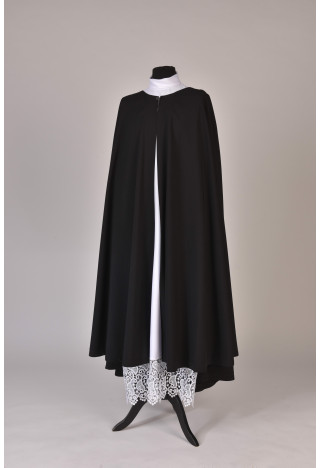
Cardinals wear a cassock made of wool or a similar fabric in the color of scarlet, complete with a sash, trimmings, stitching, and buttons made of scarlet silk, as well as a mucetta made of the same fabric. An alternative cassock for everyday use is a black cassock trimmed with crimson braid, featuring scarlet silk edging, stitching, and buttons, with the exception of the cuffs on the sleeves. The black cassock may also be adorned with a cape, likewise trimmed with scarlet braid.
With both the scarlet and black cassocks, a cardinal wears a scarlet silk sash with silk tassels. Wearing the scarlet cassock requires red stockings; with the black cassock, the choice of red stockings is optional.
Bishop’s Cassock
Few people know this, but the color associated with the office of bishop in the Middle Ages was green—green appeared on the coat of arms of every newly appointed bishop. In the 16th century, the color was changed to amaranth red (which actually resembles the color of fuchsia). The everyday cassock is made of black fabric, trimmed with amaranth-red braid, while the ceremonial cassock is solid-colored. The bishop’s cassock is tied with an amaranth-red silk sash finished with tassels. Complementary elements of the bishop’s attire include the miter and the pectoral cross hanging around the neck.
Does a cassock always have 33 buttons?
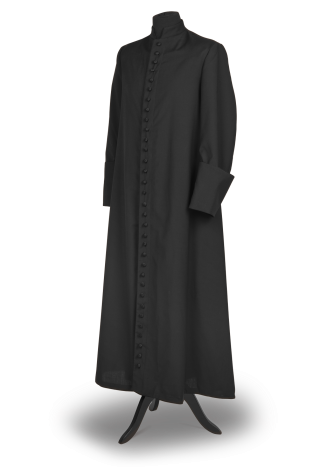
In fact, for many years, a rule was in effect requiring 33 buttons to be sewn on—a number referring to the years of Christ’s life. However, it was difficult to fit that many buttons on a low-ranking priest’s cassock, so alternative solutions were used—the remaining buttons were sewn onto the cuffs simply to uphold the tradition. Currently, this requirement no longer applies—it was abolished for practical reasons.
Is sewing a custom-made cassock a difficult task?
Despite advances in modern technology, sewing a cassock remains a very significant challenge. This garment requires a high degree of precision and accuracy, and only the best tailors are capable of sewing a cassock. The cassock must be cut properly so that it does not restrict the priest’s movements, while at the same time fitting his body well and properly highlighting the box pleats. There are few cassock manufacturers in Poland, and it is even more difficult to purchase a custom-made cassock—the wait time is generally longer, and the price is higher.
If not a cassock, then what?
A cassock isn’t always the most comfortable garment for the clergy—we’re seeing more and more priests dressed in “civilian” clothing. Here, however, the clerical collar (Latin: collare—collar), created in the 19th century, comes to the rescue. This symbolic “collar” signifies boundless devotion to God. Today, priests wear the clerical collar with a dress shirt and suit.